Protein name:
Proline-rich AKT1 substrate 1 (Proline-rich AKT substrate) ;
Alternative:
Organism:
Mouse (Mus musculus).
General Annotation
Sub Unit:
Part of the mammalian target of rapamycin complex 1 (mTORC1) which contains MTOR, LST8, RPTOR and AKT1S1. mTORC1 binds to and is inhibited by FKBP12-rapamycin. Interacts directly with RPTOR. The phosphorylated form interacts with 14-3-3 proteins and with phosphorylated AKT1 following transient focal cerebral ischemia in vivo.
Function:
Subunit of mTORC1, which regulates cell growth and survival in response to nutrient and hormonal signals. mTORC1 is activated in response to growth factors or amino-acids. Growth factor-stimulated mTORC1 activation involves a AKT1-mediated phosphorylation of TSC1-TSC2, which leads to the activation of the RHEB GTPase that potently activates the protein kinase activity of mTORC1. Amino-acid-signaling to mTORC1 requires its relocalization to the lysosomes mediated by the Ragulator complex and the Rag GTPases. Activated mTORC1 up-regulates protein synthesis by phosphorylating key regulators of mRNA translation and ribosome synthesis. mTORC1 phosphorylates EIF4EBP1 and releases it from inhibiting the elongation initiation factor 4E (eiF4E). mTORC1 phosphorylates and activates S6K1 at 'Thr-389', which then promotes protein synthesis by phosphorylating PDCD4 and targeting it for degradation. Within mTORC1, AKT1S1 negatively regulates mTOR activity in a manner that is dependent on its phosphorylation state and binding to 14-3-3. Inhibits RHEB-GTP-dependent mTORC1 activation. Substrate for AKT1 phosphorylation, but can also be activated by AKT1-independent mechanisms. May also play a role in nerve growth factor-mediated neuroprotection.
Subcellular Location:
Cytoplasm
cytosol
Found in the cytosolic fraction of the brain. Colocalizes with cortical neurons following ischemic/reperfusion injury.
Protein Attributes:
50:
MASGRPEELW | EAVVGAAERF | QARTGTELVL | LTAAPPPPPR | PGPCAYAAHG |
100:
RGALAEAARR | CLHDIAQAHR | AATATRPPGP | PPAPQPPSPA | PSPPPRPALA |
150:
REDEEEDEDE | PTETETSGER | LGGSDNGGLF | MMDEDATLQD | LPPFCESDPE |
200:
STDDGSLSEE | TPAGPTACPQ | PPATALPTQQ | YAKSLPVSVP | VWAFKEKRTE |
250:
ARSSDEENGP | PSSPDLDRIA | ASMRALVLRE | AEDTQVFGDL | PRPRLNTSDF |
Vaild Sequence:
Related Databases
Uniprot:
ELISA Kit
CLIA Kit
Polyclonal Antibody
Monoclonal Antibody
Protein
FOR
Human
Mouse
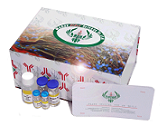
ELISA Kit for Mouse Proline-rich AKT substrate
ELISA Kit for Mouse Proline-rich AKT substrate
CLIA Kit for Mouse Proline-rich AKT substrate
CLIA Kit for Mouse Proline-rich AKT substrate
Polyclonal Antibody for Mouse Proline-rich AKT substrate
Polyclonal Antibody for Mouse Proline-rich AKT substrate
Monoclonal Antibody for Mouse Proline-rich AKT substrate
Monoclonal Antibody for Mouse Proline-rich AKT substrate
Protein for Mouse Proline-rich AKT substrate
Protein for Mouse Proline-rich AKT substrate
R&D Technical Data
For more information, please refer to the manual,Or contact our technical support: tech@eiaab.com.
For more information, please refer to the manual,Or contact our technical support: tech@eiaab.com.
For more information, please refer to the manual,Or contact our technical support: tech@eiaab.com.
For more information, please refer to the manual,Or contact our technical support: tech@eiaab.com.
For more information, please refer to the manual,Or contact our technical support: tech@eiaab.com.
For more information, please refer to the manual,Or contact our technical support: tech@eiaab.com.
For more information, please refer to the manual,Or contact our technical support: tech@eiaab.com.
For more information, please refer to the manual,Or contact our technical support: tech@eiaab.com.
For more information, please refer to the manual,Or contact our technical support: tech@eiaab.com.
For more information, please refer to the manual,Or contact our technical support: tech@eiaab.com.
Precision
For more information, please refer to the manual,Or contact our technical support: tech@eiaab.com.
For more information, please refer to the manual,Or contact our technical support: tech@eiaab.com.
For more information, please refer to the manual,Or contact our technical support: tech@eiaab.com.
For more information, please refer to the manual,Or contact our technical support: tech@eiaab.com.
For more information, please refer to the manual,Or contact our technical support: tech@eiaab.com.
For more information, please refer to the manual,Or contact our technical support: tech@eiaab.com.
For more information, please refer to the manual,Or contact our technical support: tech@eiaab.com.
For more information, please refer to the manual,Or contact our technical support: tech@eiaab.com.
For more information, please refer to the manual,Or contact our technical support: tech@eiaab.com.
For more information, please refer to the manual,Or contact our technical support: tech@eiaab.com.
Recovery
For more information, please refer to the manual,Or contact our technical support: tech@eiaab.com.
For more information, please refer to the manual,Or contact our technical support: tech@eiaab.com.
For more information, please refer to the manual,Or contact our technical support: tech@eiaab.com.
For more information, please refer to the manual,Or contact our technical support: tech@eiaab.com.
For more information, please refer to the manual,Or contact our technical support: tech@eiaab.com.
For more information, please refer to the manual,Or contact our technical support: tech@eiaab.com.
For more information, please refer to the manual,Or contact our technical support: tech@eiaab.com.
For more information, please refer to the manual,Or contact our technical support: tech@eiaab.com.
For more information, please refer to the manual,Or contact our technical support: tech@eiaab.com.
For more information, please refer to the manual,Or contact our technical support: tech@eiaab.com.
Linearity
For more information, please refer to the manual,Or contact our technical support: tech@eiaab.com.
For more information, please refer to the manual,Or contact our technical support: tech@eiaab.com.
For more information, please refer to the manual,Or contact our technical support: tech@eiaab.com.
For more information, please refer to the manual,Or contact our technical support: tech@eiaab.com.
For more information, please refer to the manual,Or contact our technical support: tech@eiaab.com.
For more information, please refer to the manual,Or contact our technical support: tech@eiaab.com.
For more information, please refer to the manual,Or contact our technical support: tech@eiaab.com.
For more information, please refer to the manual,Or contact our technical support: tech@eiaab.com.
For more information, please refer to the manual,Or contact our technical support: tech@eiaab.com.
For more information, please refer to the manual,Or contact our technical support: tech@eiaab.com.
References
1.
[15/1/25 17:38] Upload to ab completed in less than a minute: 1 file transferred (13.4 Kb/s)
Cited for PHOSPHORYLATION [LARGE SCALE ANALYSIS] AT SER-203; SER-204; SER-212 AND SER-213;IDENTIFICATION BY MASS SPECTROMETRY [LARGE SCALE ANALYSIS]
tissue :
Liver .
2.
"The transcriptional landscape of the mammalian genome."
Carninci P.
,
Kasukawa T.
,
Katayama S.
,
Gough J.
,
Frith M.C.
,
Maeda N.
,
Oyama R.
,
Ravasi T.
,
Lenhard B.
,
Wells C.
,
Kodzius R.
,
Shimokawa K.
,
Bajic V.B.
,
Brenner S.E.
,
Batalov S.
,
Forrest A.R.
,
Zavolan M.
,
Davis M.J.
,
Wilming L.G.
,
Aidinis V.
,
Allen J.E.
,
Ambesi-Impiombato A.
,
Apweiler R.
,
Aturaliya R.N.
,
Bailey T.L.
,
Bansal M.
,
Baxter L.
,
Beisel K.W.
,
Bersano T.
,
Bono H.
,
Chalk A.M.
,
Chiu K.P.
,
Choudhary V.
,
Christoffels A.
,
Clutterbuck D.R.
,
Crowe M.L.
,
Dalla E.
,
Dalrymple B.P.
,
de Bono B.
,
Della Gatta G.
,
di Bernardo D.
,
Down T.
,
Engstrom P.
,
Fagiolini M.
,
Faulkner G.
,
Fletcher C.F.
,
Fukushima T.
,
Furuno M.
,
Futaki S.
,
Gariboldi M.
,
Georgii-Hemming P.
,
Gingeras T.R.
,
Gojobori T.
,
Green R.E.
,
Gustincich S.
,
Harbers M.
,
Hayashi Y.
,
Hensch T.K.
,
Hirokawa N.
,
Hill D.
,
Huminiecki L.
,
Iacono M.
,
Ikeo K.
,
Iwama A.
,
Ishikawa T.
,
Jakt M.
,
Kanapin A.
,
Katoh M.
,
Kawasawa Y.
,
Kelso J.
,
Kitamura H.
,
Kitano H.
,
Kollias G.
,
Krishnan S.P.
,
Kruger A.
,
Kummerfeld S.K.
,
Kurochkin I.V.
,
Lareau L.F.
,
Lazarevic D.
,
Lipovich L.
,
Liu J.
,
Liuni S.
,
McWilliam S.
,
Madan Babu M.
,
Madera M.
,
Marchionni L.
,
Matsuda H.
,
Matsuzawa S.
,
Miki H.
,
Mignone F.
,
Miyake S.
,
Morris K.
,
Mottagui-Tabar S.
,
Mulder N.
,
Nakano N.
,
Nakauchi H.
,
Ng P.
,
Nilsson R.
,
Nishiguchi S.
,
Nishikawa S.
,
Nori F.
,
Ohara O.
,
Okazaki Y.
,
Orlando V.
,
Pang K.C.
,
Pavan W.J.
,
Pavesi G.
,
Pesole G.
,
Petrovsky N.
,
Piazza S.
,
Reed J.
,
Reid J.F.
,
Ring B.Z.
,
Ringwald M.
,
Rost B.
,
Ruan Y.
,
Salzberg S.L.
,
Sandelin A.
,
Schneider C.
,
Schoenbach C.
,
Sekiguchi K.
,
Semple C.A.
,
Seno S.
,
Sessa L.
,
Sheng Y.
,
Shibata Y.
,
Shimada H.
,
Shimada K.
,
Silva D.
,
Sinclair B.
,
Sperling S.
,
Stupka E.
,
Sugiura K.
,
Sultana R.
,
Takenaka Y.
,
Taki K.
,
Tammoja K.
,
Tan S.L.
,
Tang S.
,
Taylor M.S.
,
Tegner J.
,
Teichmann S.A.
,
Ueda H.R.
,
van Nimwegen E.
,
Verardo R.
,
Wei C.L.
,
Yagi K.
,
Yamanishi H.
,
Zabarovsky E.
,
Zhu S.
,
Zimmer A.
,
Hide W.
,
Bult C.
,
Grimmond S.M.
,
Teasdale R.D.
,
Liu E.T.
,
Brusic V.
,
Quackenbush J.
,
Wahlestedt C.
,
Mattick J.S.
,
Hume D.A.
,
Kai C.
,
Sasaki D.
,
Tomaru Y.
,
Fukuda S.
,
Kanamori-Katayama M.
,
Suzuki M.
,
Aoki J.
,
Arakawa T.
,
Iida J.
,
Imamura K.
,
Itoh M.
,
Kato T.
,
Kawaji H.
,
Kawagashira N.
,
Kawashima T.
,
Kojima M.
,
Kondo S.
,
Konno H.
,
Nakano K.
,
Ninomiya N.
,
Nishio T.
,
Okada M.
,
Plessy C.
,
Shibata K.
,
Shiraki T.
,
Suzuki S.
,
Tagami M.
,
Waki K.
,
Watahiki A.
,
Okamura-Oho Y.
,
Suzuki H.
,
Kawai J.
,
Hayashizaki Y.
more...
Science309:1559-1563(2005)
[
PubMed ]
[
Europe PMC ]
[
Abstract ]
[15/1/25 17:38] Upload to ab completed in less than a minute: 1 file transferred (13.4 Kb/s)
Cited for NUCLEOTIDE SEQUENCE [LARGE SCALE MRNA]
strain :
C57BL/6J . strain :
NOD . tissue :
Embryo .
3.
[15/1/25 17:38] Upload to ab completed in less than a minute: 1 file transferred (13.4 Kb/s)
Cited for NUCLEOTIDE SEQUENCE [LARGE SCALE MRNA]
tissue :
Lung .
4.
[15/1/25 17:38] Upload to ab completed in less than a minute: 1 file transferred (13.4 Kb/s)
Cited for FUNCTION;SUBUNIT;SUBCELLULAR LOCATION
5.
[15/1/25 17:38] Upload to ab completed in less than a minute: 1 file transferred (13.4 Kb/s)
Cited for IDENTIFICATION BY MASS SPECTROMETRY [LARGE SCALE ANALYSIS]
tissue :
Embryonic brain .
6.
[15/1/25 17:38] Upload to ab completed in less than a minute: 1 file transferred (13.4 Kb/s)
Cited for FUNCTION



 Vaild Sequence: